I would describe myself as an avid music fan. I span lots of different genres (from R&B to hip hop to punk to indie to EDM), and I'm constantly hunting for new music. I frequently DJ for my friends if we're having a kickback. I get handed the AUX rather often. In my own time, I am almost constantly listening to music. It's important to have your music saved in some way so that you can not only be a crowd pleaser, but also set the mood for your own day. But, I hate playlists.
My frustrations with playlists come from the need to maintain them. If I don't maintain my playlists then my playlists grow very long (100+ songs), and they start to become really cluttered. I will still have songs I don't really like anymore because my music taste has changed. My initial mood that I was aiming for will have shifted so much that my playlist loses focus. This is really inconvenient for when I'm listening to music while doing something (playing video games, working out, driving, etc.) since it's a lot harder for me to skip a song or fix the song queue so my transitions between my songs are less jarring. And despite all of these frustrations, I live with it. Because I find maintaining playlists to be even more of a chore. It's a lot of upfront work for something that happens constantly, but isn't a major inconvenience, as even a bad song will still only last 4 minutes on average.
Some of my other frustrations include having failed playlists. Sometimes I'm really into a mood but only have 5 songs that fit into that category. I don't want to listen to a playlist that's only 5 songs long because it'll repeat within 15–20 minutes and I'll grow bored of those songs very quickly. So the playlist just sits in my catalog, forgotten and unused. And it stays like that because I'm also incredibly frustrated with how hard it is to find new music when I'm looking for something a little more specific.
I very rarely have successfully found a song similar to what I'm looking for through a machine generated recommendation. While I will occasionally find songs on playlists curated by Spotify or Youtube, starting a radio on a song that I really enjoy is rather unsuccessful. Artists will sometimes bend genres and will usually shift sounds throughout an entire album. Sometimes I'm looking for a specific sound, but if I start a radio then I get songs that are more related to an artist's more usual sound which is not what I'm looking for most of the time. For example, I fell in love with "SMUCKERS" by Tyler, the Creator. I love the jazzy samples. I love the beat switch. The horns in the background give it a strong, pumped up but still summer-y feel. The flows were good; the bars were good. I had this song on repeat. I started a radio on this specific song and this is what I get:
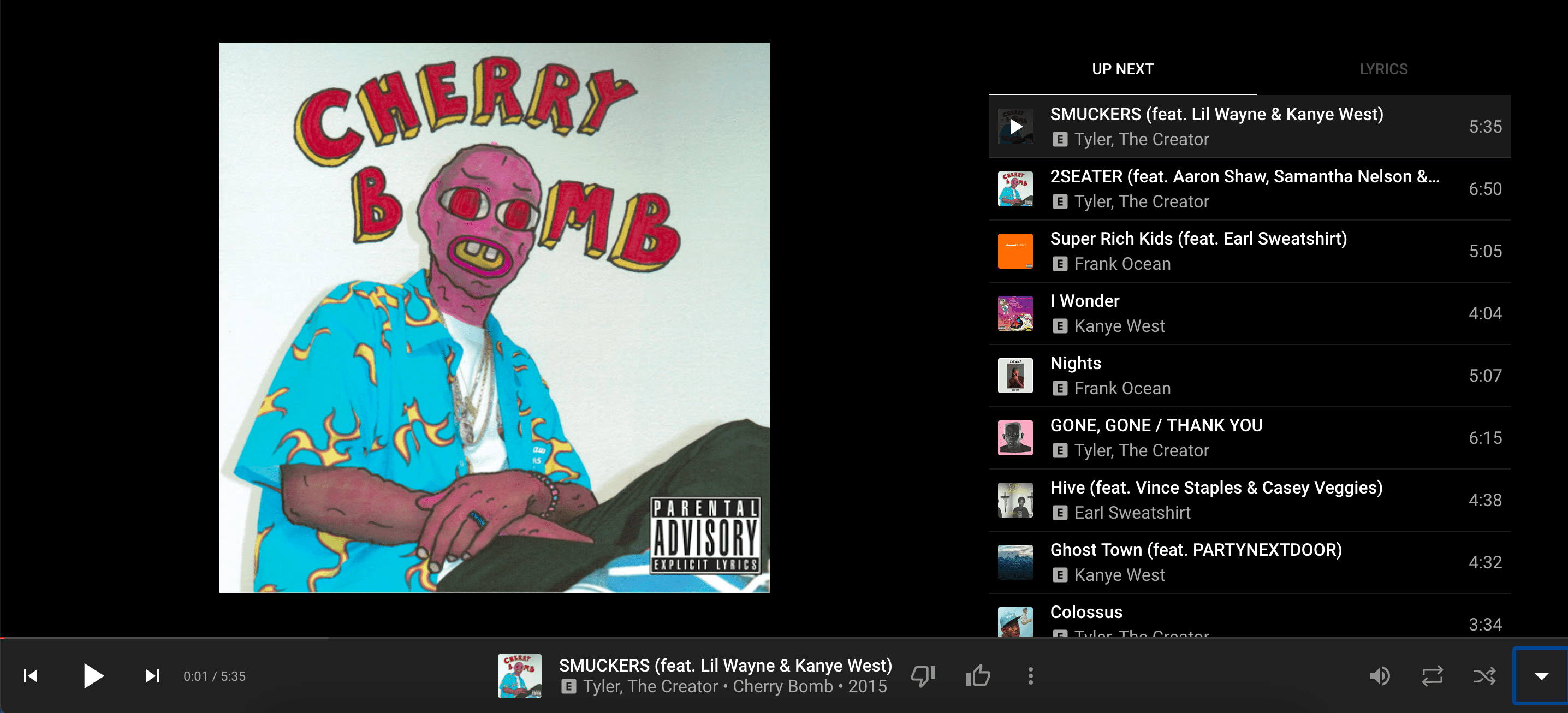
This queue features songs from Tyler, Kanye West, Frank Ocean, and Earl Sweatshirt. It makes sense that the algorithm would recommend more songs from the same artist. "2SEATER" is a decent recommendation, though it's a lot more somber in tone. But it shares jazzy instrumentals and a beat switch. "Colossus" is also an okay recommendation, but is also a lot more somber with its piano instrumental. However, Tyler is also the perfect example why recommending songs from the same artist doesn't always work. "GONE, GONE / THANK YOU" is off of his latest album, IGOR, and is very much not a hip hop album. "SMUCKERS" does have a Kanye inspired sound, but it's a bit more reminiscent of his College Dropout / Late Registration days. "I Wonder" is an okay recommendation with its uplifting tone and piano keys, but features a more synthy beat and a slower pace. "Ghost Town" is off of one of Kanye's most recent work, Ye, and is very different from his early work, featuring a heavy guitar driven beat and more sing-songy approach. Frank Ocean makes R&B music. The algorithm is likely recommending Frank Ocean because the two artists are heavily associated as they both came up as a part of Odd Future. Tyler has toyed with more R&B sounds, especially on Flower Boy, but "SMUCKERS" is not one of those tracks. Earl Sweatshirt similarly was a part of Odd Future and is associated with Tyler. However, "Hive" is a dark minimal hip hop banger. It's clear the algorithm here is just recommending songs from similar artists as all artists that appear here are either heavily associated (Earl Sweatshirt and Frank Ocean), or used to have a similar sound (Kanye West). I consider 3 out of the 8 songs okay to decent recommendations (37.5%), but not one is a good recommendation. They all fail to match the energy and jazzy sound that "SMUCKERS" has.
User Data
I conducted user interviews with 10 of my friends because I wanted to know if people shared my frustrations or if it's something that's more niche. My data is not representative of every single music listener, but the college age range (18–24) makes up about a quarter of Spotify users1. Within my 10 friends, I interviewed 3 people who considered themselves hardcore music fans, 3 people who considered themselves very casual music fans, and 4 people who considered themselves to be in the middle. I defined hardcore music fan as someone who listens to a lot of music and treats it like a hobby. I defined casual music fan as someone who just listens to music and may not necessarily care about albums, but more so just songs they like or find catchy.
Number of playlists ranged anywhere between 7 and 108. The median number of playlists was 15. Percentage of playlists in active use ranged from 0% to 50%. The median percentage was around 25%. It became very clear to me that playlists are rather inefficient. While it may be manageable to have playlists you don't really touch anymore when you only have about 10 playlists. It can quickly become cluttered and annoying once its over 20 playlists which clearly does happen.
I have one friend who has 108 playlists because he was so meticulous and specific with his playlists. He created folders of genres like hip hop or k-pop and then created several playlists in those folders that were subgenres. His library was very organized but required over 100 playlists to do so which is rather daunting for most music listeners. He even maintains the playlists and will delete songs or even playlists if they haven't seen much use recently.
On the other end, I have two friends who have given up entirely on playlists lately. One will instead just use her collection of liked songs. More than half of her playlists were actually just collection of songs from a single artist anyways, in order to avoid going through the pains of shuffling through an artist's discography from the Spotify page. The other will either listen to artists/albums or Spotify created playlists (e.g. Lorem). She has attempted to make playlists but they all ended up being failed projects with a very, very short songlist so they never end up being used.
A common theme with playlists that didn't occur to me was the sentimental value of playlists. Half of the 10 people interviewed mentioned making playlists for time periods (e.g. start of a new year or semester). Two people explicitly said they would almost never delete songs off their old playlists because it is a marker of their music taste at that moment in time. They liked to go back and see what they used to listen to even if they don't really like it as much anymore. This is a valid point and I can certainly see the value in it. I never experienced this because I constantly add on to my playlists instead of creating new ones so I never really get a time capsule.
Six of my friends expressed problems with Spotify's Discover Weekly or similar computer generated recommendations (e.g. Youtube autoplay). Four of those six specifically had the same problem. They felt that the algorithm was a little too tuned in to what they were listening to. For example, one of my friends listens to mainly sad indie music. Their Spotify Discover Weekly is now full of just sad indie music which was frustrating when she wanted to listen to something new. This can easily end up being a cyclical problem. Someone could have a lot of trouble breaking out of a single genre if that's the only thing Spotify recommends because that's the only thing they listen to because that's the only thing Spotify recommend etc.
And when these playlists are used, it can be similar to thrift shopping, an analogy one of my friend makes. There is a lot to sift through but you will find a gem eventually. Another one of my friends considered this method moderately successful because they find at least one song they like every two times they listen to their Discover Weekly playlist. While I'm glad that they are happy with that success rate, to me, that sounds incredibly inefficient. The highest success rate my friends gave me was finding 2 songs after listening to 10. There is clearly a lot of room for improvement in terms of recommending songs, which is certainly a subjective and complex problem.
Personas
My user interviews with my friends helped reassure me that I'm not the only person with this problem. Using the data I collected from my friends, I created personas of music listeners.
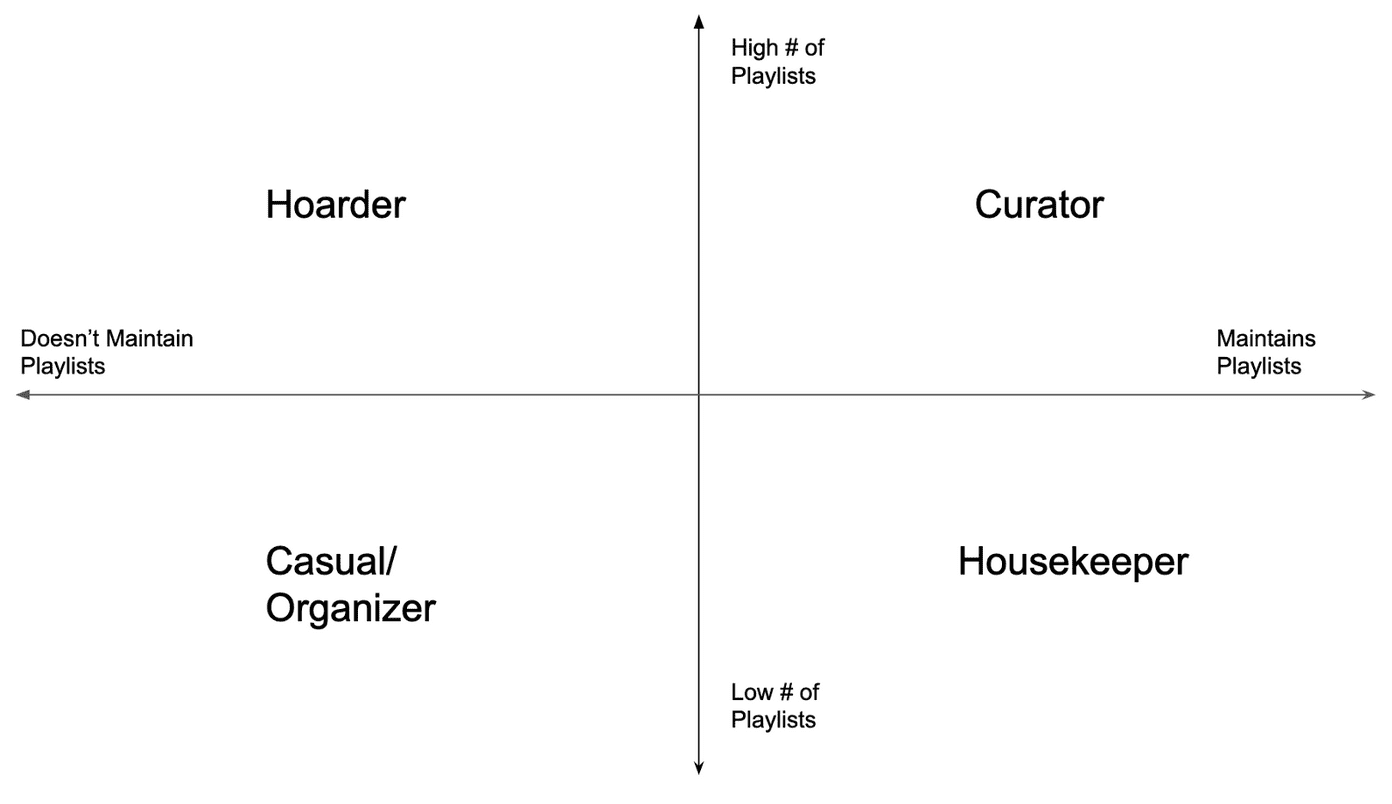
Playlists are collections of songs, so you can think of these personas in terms of how 'neat' they are with their music.
A Curator is someone who is a hardcore music fan that creates a lot of playlists with specific niches and works really hard to make sure each playlist is something they are content with. Their playlists are focused and on the shorter side since their playlists are very specific. This is my friend who has 108 playlists total and makes use of folders to break genres down (e.g. hip hop) into its subgenres (e.g. trap, jazzy, summery).
A Hoarder is someone who also listens to a lot of music, but is much less organized about it. They may not actively seek music as much as a Curator would, but whenever they find new music that they like they have to add it to some playlist so that they have it somewhere. As a result, their playlists tend to be on the longer side (since they never go back to trim any fat) and can be much less focused as songs will vary wildly in genre or mood. They will make a lot of playlists in attempts to fill some niche but may not fully follow through or lose track of the original goal during the process.
A Housekeeper is someone who is similar to a Curator but may not be as into music. Playlists are used for needs (e.g. study music, workout music) rather than for just enjoyment. They don't have a lot of playlists or a lot of music necessarily, but they make sure that what they have is good. They tend to be more content with their playlists (and will actively use more percentage wise on average). Their playlists will tend to be a bit of a mish-mash as they don't have enough playlists to separate some of the genres or mood, but it's at the very least, full of songs that they do really enjoy; it just depends on the occasion.
I found that a low number of playlists and not maintaining playlists seem to manifest in two ways: Casual and Organizer. Someone who is Casual just isn't that into music. They don't have a lot of music they listen to so they don't really have the need for a large number of playlists or even to maintain them sometimes. They will usually opt for other mediums (e.g. listening to podcasts, using machine generated playlists, listening to the radio). An Organizer is someone who has a small number of playlists, typically categorized just by genre. Everything is loosely organized because of these broad categorizations. Their playlists will wind up being really long as they continuously add songs that fit into the genre, but they never go back to delete songs they don't listen to anymore. Their playlists can vary wildly in mood as they are not broken into subgenres. They will likely find themselves a little frustrated constantly skipping songs when shuffling a playlist as they will get jarring mood shifts and lots of songs they don't enjoy anymore.
I would categorize myself as an organizer. I don't have the energy to further divide my playlists into smaller parts like a Curator would and as a result, I find myself frustrated with my playlists that grow too long and are full of songs that I don't really like anymore. It's to the point that I remake playlists roughly once a year, but then I have an aversion to adding songs that were in my old playlists since I find it unnecessary to have it in both playlists when I don't delete my old playlists, so I end up forgetting songs that I still really like. I'm at my happiest with my playlists the first two weeks or so after making it.
Song Tags
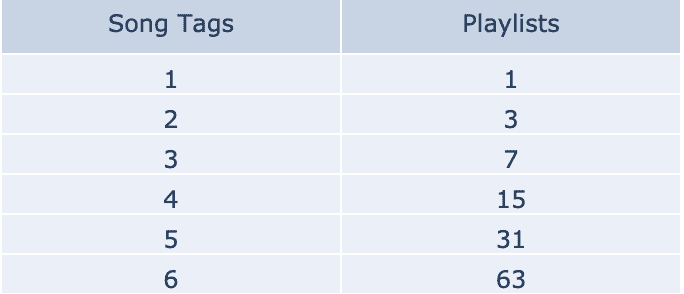
If I were to redesign playlists to alleviate some of these pain points, I would create a system of songs tags. Functionally, when putting on music, it wouldn't be too different from a playlist. The highlight of it is the versatility and ease of use. You could tag a song with custom tags and with as many as you want. Let's revisit my SMUCKERS example. I would tag it as (jazzy)(hip-hop)(summer)(hype). SMUCKERS would have a chance of coming on in any combination of those tags (e.g. I want to play hip-hop music), with obviously a higher chance as I get more specific with my tags (e.g. I want jazzy summer hip-hop). This eliminates the need of either creating several small playlists like a Curator might but needing to queue several playlists when looking to listen to a broader genre (which requires 2n extra clicks where n is the number of total subgenre playlists) or creating literally every combination of those tags. For 4 tags, this would mean needing 15 playlists. The more you might categorize a song, the more efficient this process becomes.
Song tags also have an added benefit for songs that don't have a defined genre. It's very common these days for artists to experiment and bend genres. This has constantly led me to wonder where do I put this song in my genre-defined playlists. If I feel a song borders hip hop and R&B, then I struggle with where to put it. It feels wrong and redundant to add it to both playlists. I will often just not add a song to any playlist if I can't figure out where it belongs. Similarly, I will sometimes make failed playlists where I only have less than 10 songs because I've made it too niche and I don't have enough songs that fall under this category. Being able to tag a song with multiple genres helps define it but also feels less committal than putting it under a specific playlist that isn't too niche to actually fill. Multi genre songs can even serve as transitions. If you want to listen to multiple genres at once, the algorithm could try its best to link genres by using songs that are tagged with multiple. This makes for a smoother and more enjoyable listening experience.
The second major change this would bring is that it would streamline the process for finding new songs. When starting a radio on a song, the algorithm would suggest other songs that users have also tagged. It wouldn't look for songs with the same exact tags as some users would likely take advantage of custom tags with weird names as some do already with their playlists and that would be unhelpful for them. The algorithm would start with songs that other users have tagged with multiple same tags and then go on to recommend songs with fewer tags. This way we start with songs that are most similar and slowly move into songs that are less similar. The algorithm could also be modified to favor more similar songs over more popular ones to avoid the cyclical problem streaming services currently have and allow users to discover more lesser known artists. This would allow users to find new music significantly more successfully.
The drawbacks to my idea are that it does not benefit someone who is Casual. This system is a much better system for users who have a lot of music to organize and for users who want to find a lot more music. Someone who is casual falls into neither category and therefore only experiences a system that has no benefit to them. However, this system still fulfills most playlist capabilities so they don't lose anything, but the system is a little more complicated. I would argue that streaming services don't care quite as much about these people as they are likely the least active users so streaming services don't need to cater to them as much.
Song tags do lose some playlist capabilities. For example, three friends expressed the idea that playlists have sentimental values. They liked to look back at their old playlists occasionally as a method of reminiscing. I had one friend who would make playlists for their friend and they would both listen to playlists in order usually. These two are utilizing playlists to their full capacities-essentially making a mixtape for a close friend to listen to in order-and will certainly be missing functions with this new system, but these kinds of people are likely a minority.
In the end, this new system does not have to replace playlists necessarily. However, it's expensive to build an entirely new system and song tags would likely be more complex than the current system. Song tags bring a lot of added benefits, but is not an entirely new system and functionally is very similar to playlists. Is it worth dedicating a lot of resources for a system that isn't even strictly better than the old one?
I argue yes. Playlists are an outdated system. Only a minority still use playlists completely for its intended use. The more common way to listen to music these days is to put a playlist on shuffle which I argue is more radio-esque. Song tags fulfills this niche much better than playlists do. Song tags essentially allow you to categorize your music and make a radio out of your music. It keeps the variety that radios bring and is much more versatile than playlists. Song tags not only allow us to sort our music in a more efficient manner, but also discover new music in a more efficient manner. The ability to find songs that are a closer match in terms of sound, vibe, and genre gives the user better recommendations. Playlists are the equivalent to making mixtapes and burning them on to a blank CD for close friends or lovers to listen to in order back in the day. It's time to modernize playlists and how we find music.